


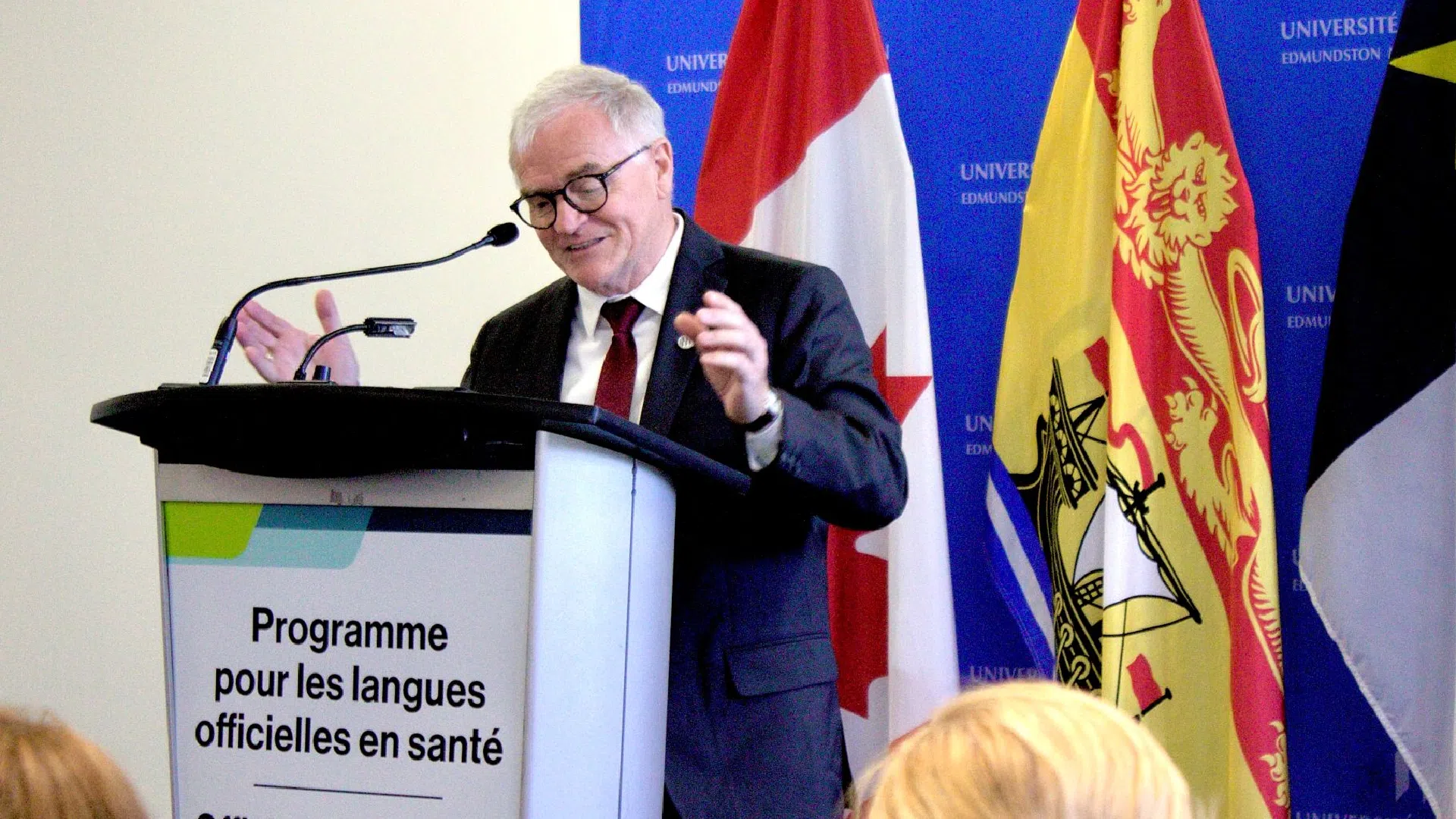
Ottawa has announced more than $29 million in funding to help train more francophone health-care professionals in New Brunswick.
The funding will be split between l’Université de Moncton, the Centre formation médicale du Nouveau-Brunswick (New Brunswick Medical Training Centre) at the university, and the Collège communautaire du Nouveau-Brunswick (CCNB).
Moncton-Dieppe MP Ginette Petitpas Taylor said it is crucial that francophones in minority communities can access health care in their language of choice.
“I often say when we live a crisis, we live a crisis in our in our mother tongue, and as a result, it’s truly important to ensure that when we are accessing the health-care services, because oftentimes we are in crisis, that we are going to be able to access those services in our mother tongue,” Petitpas Taylor told reporters following Wednesday’s
“That is why the announcement today is extremely important in order to ensure that our health-care professionals, our students, are going to be able to receive the training in the French language, and we’ll be able to offer that service in those communities as well.”
Nearly $14M for l’Université de Moncton
L’Université de Moncton will receive the biggest chunk of change at nearly $13.8 million to increase the number of students enrolling in several health programs.
That includes bachelor’s in nutrition, baccalaureate in nursing sciences, master’s degree for nurse practitioners, certificate and master’s degree in health services management, bachelor’s degree in social work and doctorate in psychology.
Dr. Denis Prud’homme, president of the university, told reporters that this is key funding, adding that it has allowed the post-secondary institution to provide students with the infrastructure that they need.
“If we think about the nursing program, we need a high-quality simulation laboratory, which is very costly, and without that funding, we were not able to provide our students those high-tech facilities,” he said.
“We serve students coming from rural communities in the region, and we need to support them to go back to do some internships, so we need to provide some funding for travelling support, sometimes for lodging.”
Prud’homme said the money has also helped the university with promotions and recruitment, and allowed them to offer scholarships to help students apply to those programs.
“We were not able in the past to maximize the enrollment in our programs, but since the last couple of years, we are at our maximum capacity, and in some programs, we are over our capacity,” he added.
Other post-secondary institutions receiving funding
The Centre formation médicale du Nouveau-Brunswick (New Brunswick Medical Training Centre) will get $10.4 million to increase the number of students enrolling in their undergraduate medicine program.
CCNB will receive more than $4.9 million to increase enrollment in several health programs, including personal support work, auxiliary nurse, paramedical care, mental health intervention techniques and aging, pharmacy techniques, rehabilitation techniques, medical electrophysiology technology (cardiology), medical radiation techniques, respiratory therapy and dental assistant.
The funding is part of more than $78 million announced over five years to seven organizations to improve access to health services in French for francophone communities.
Société Santé en français (SSF) will receive more than $37 million to deploy health networking activities in partnership with its 16 networks across the country, including $3.2 million for its New Brunswick network.
Association des collèges et universités de la francophonie canadienne – Consortium national de formation en santé will get nearly $9.5 million for a project that aims to increase access, recruitment and training to health programs in francophone post-secondary institutions, as well as offer more internship and placement opportunities in francophone minority communities.