


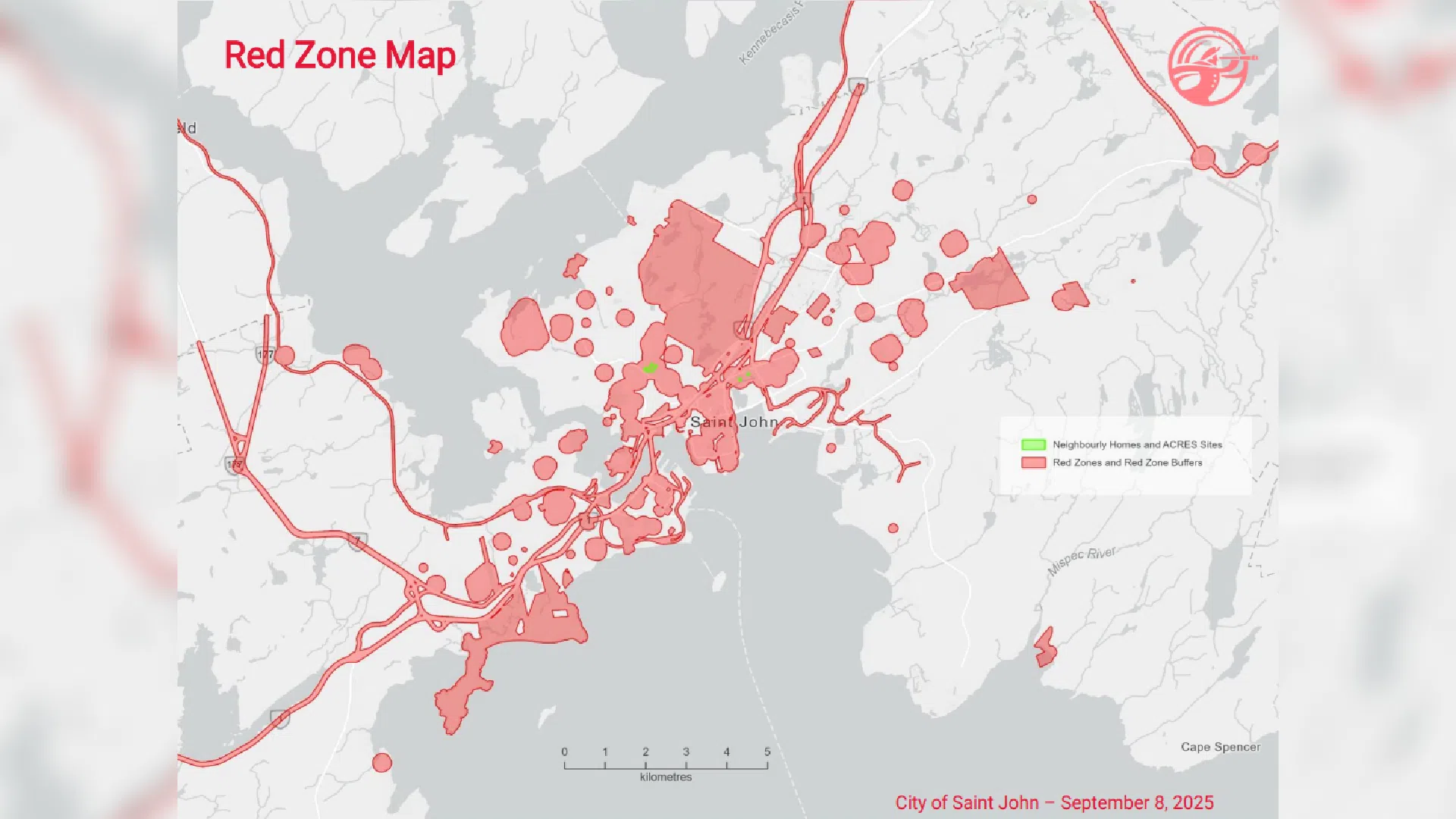
The City of Saint John has outlined areas of the community where tents, encampments and temporary shelters will not be allowed.
The so-called Red Zones, which are part of the city’s Housing for All Strategy, were unveiled at Monday night’s council meeting.
These include schools, daycares, early learning centres, licensed afterschool programs, special needs centres, crisis care facilities and emergency shelters, playgrounds, splash pads, sports fields, designated parks, provincially designated highways, railways, Harbour Passage, cemeteries and designated Green Zones.
In addition, there will be buffers of 200 metres around schools, childcare centres, Green Zones and crisis care facilities, 100 metres around playgrounds and splash pads, 30 metres around sports fields, parks, highways and railways, and five metres around the Harbour Passage walkway.
Relocation plans
According to the city, outreach teams will work with people living in encampments to create relocation plans and connect them with appropriate housing, shelter or Green Zone options.
Staff will focus on higher-risk Red Zones starting Sept. 23 and lower-risk zones on Oct. 6, with a goal of having no tents, encampments or temporary shelters remaining in those areas by the end of October.
A staff report to council on Monday night said 96 per cent of people relocate voluntarily. Relocation action will be taken by the city and police, if necessary.
“The City of Saint John is committed to a person-centred, compassionate, and rights-based approach,” said the news release.
The city said it will also work with private property owners in Red Zones who do not want tents on their property and are requesting help.
“Every person in our city deserves dignity, safety, and the chance to move toward permanent housing,” Mayor Donna Noade Reardon said in a news release on Monday evening.
“By creating both Green and Red Zones, we are balancing compassion with responsibility and ensuring that those experiencing homelessness are supported with real alternatives, while protecting the safety of our neighbourhoods, schools, and community spaces.”
In May, city officials announced two Green Zones — one on Egbert Street and another on Thorne Avenue — where a total of 54 transitional housing units will be built.
The Egbert Street officially opened in July and the Thorne Avenue location is expected to welcome residents by December.
Somerset ACRES, a 21-unit transitional housing pilot in the Crescent Valley neighbourhood, is also considered a Green Zone.
Yellow Zones
All other areas of the city will be designated as Yellow Zones and tents will be allowed temporarily, provided permission is given by the landowner.
City officials said they will not remove tents on certain vacant city-owned land in those zones, provided certain criteria and site standards are followed.
There must be at least three metres between tents and no more than five tents in a cluster, and tent clusters must be at least 50 metres apart.
Temporary wooden structures will not be allowed, and sites must be kept clean and orderly.
Councillor wants encampments removed from all city-owned land
Meanwhile, one city councillor is calling for encampments to be removed from all city-owned and managed land across Saint John.
Coun. Greg Norton introduced a notice of motion at Monday’s meeting. It is scheduled to be debated and voted on at the Sept. 22 meeting.
It would direct the city’s chief administrative officer to coordinate the removal of encampments on city-owned and managed land between Sept. 22 and Oct. 6.
The motion would also allow the city to work with partners to remove encampments on provincial and federal lands within Saint John. It could also use existing enforcement powers to get rid of encampments on private land.
Norton also wants council to have the ability to declare a state of local emergency to remove encampments, structures and hazards on any lands when conditions “pose an immediate risk to life, health, or safety that cannot be mitigated by ordinary enforcement.”
The councillor’s motion also calls for staff to present a public report at council to detail any actions taken and “recommended measures to prevent re-establishment.”