


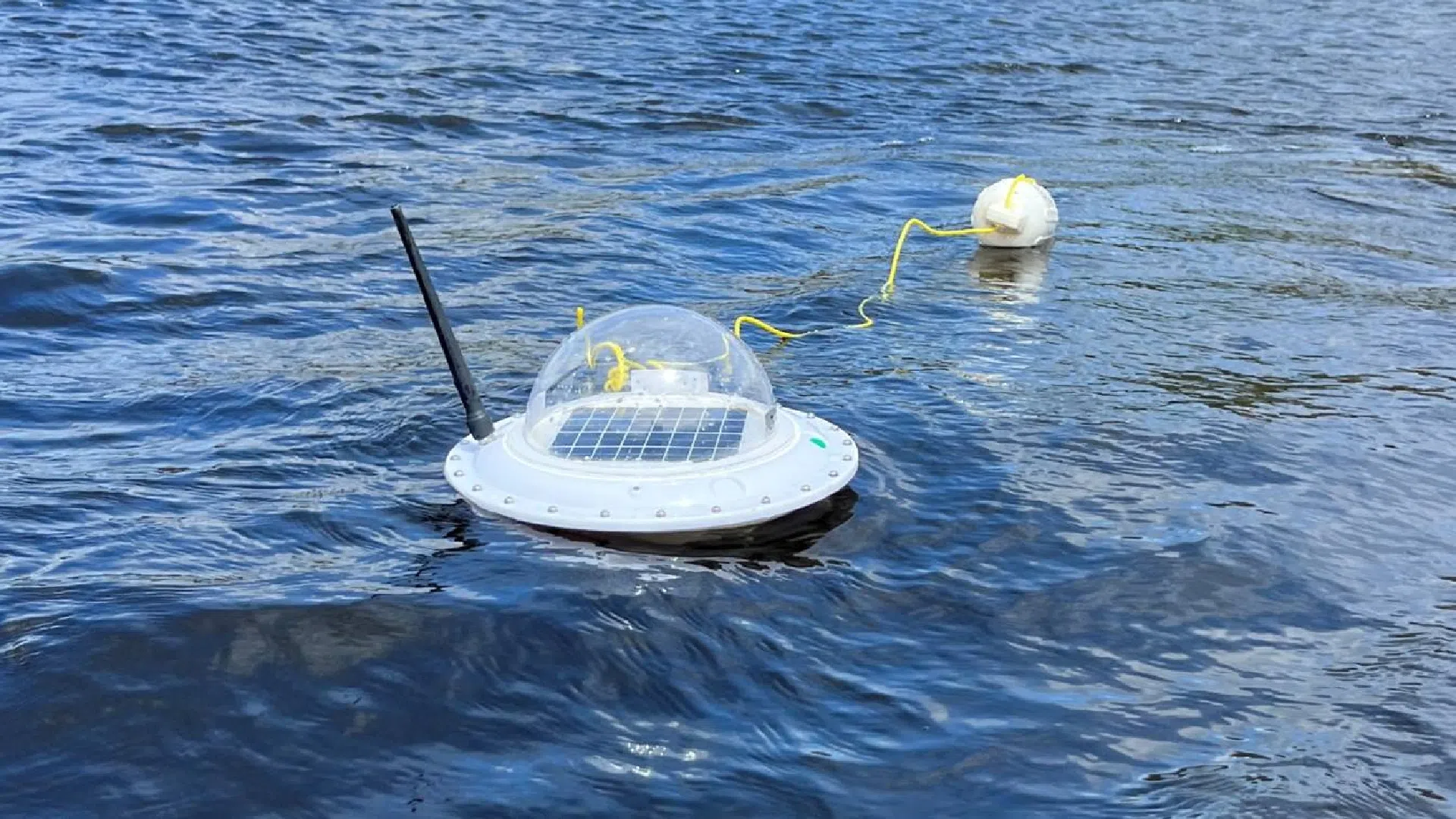
A New Brunswick organization is tracking cyanobacteria in provincial waterways as it works to learn more about the bacteria.
The Hammond River Angling Association has deployed more than a dozen cyano trackers along the Saint John River watershed.
“It’s a little solar-powered device that kind of looks like a UFO in the water,” Sarah Blenis, the project manager with the association, told our newsroom.
“This is collecting data on precipitation, air temperature, water temperature, turbidity, phycocyanin and chlorophyll.”
Blenis said the data helps to give them an early alert so they know when a cyanobacteria bloom may be forming in the area.
What are cyanobacteria?
Cyanobacteria, also known as blue-green algae, are a natural part of our environment and water ecosystems, and can be found in many ponds, lakes, rivers and wetlands.
Blooms usually occur when temperatures get warmer, typically in the late spring and early summer. Under certain conditions, they can grow quickly and clump together to form surface blooms or benthic mats.
Although most cyanobacteria are not dangerous, some strains release toxins that are harmful to humans and animals. These toxins can irritate the skin, eyes, and throat, and may cause stomach discomfort if they are swallowed.
Surface blooms typically appear blue-green but can also be green, red, or brown, according to the province. Benthic mats form along the bottom of lakes and rivers and often wash ashore in dark hues, posing a particular threat to pets.
Cyanobacteria advisories are in place for several New Brunswick waterways. Public Health said advisories remain in place indefinitely due to the unpredictability of cyanobacteria blooms.
Greater understanding of cyanobacteria
The Hammond River Angling Association began using cyano trackers on Darlings Lake in the Hampton area in 2021. Blenis said this is the biggest year for the project so far.
The Canada Water Agency supports the project in partnership with several environmental non-profit groups throughout the province.
Blenis said a greater understanding of cyanobacteria in general is one of the big takeaways they hope to get from this project.
“As well as the potential risks it poses to the public, and the steps that the public can take in helping to decrease the likelihood of some of these blooms,” she added.
To decrease the likelihood of blooms, she encourages the public to keep natural vegetation surrounding water bodies in place, make sure your septic tank is not leaking into surrounding waterways, and reduce the amount of fertilizer used for agriculture or on lawns.